

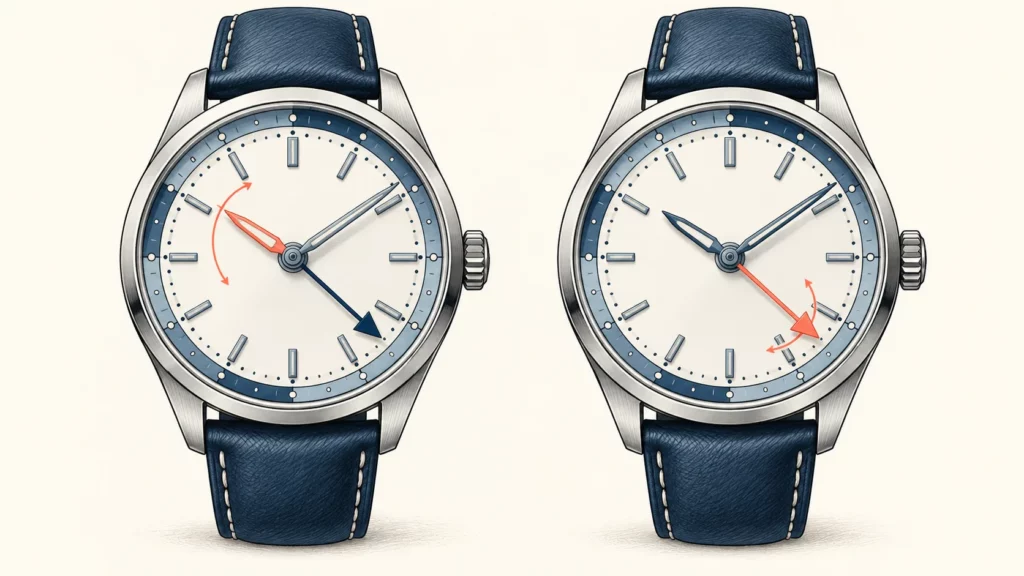
Flyer GMT vs Caller GMT: what is the difference and which one should you choose?
In brief: both types of GMT watches display a second time zone thanks to a hand that makes one complete revolution of the dial in 24 hours. The difference lies in the adjustment: on a Flyer GMT, the local time is easily adjusted; on a Caller GMT, the GMT hand is adjusted. Do you travel often? The Flyer GMT is generally more practical. Do you mainly want to know the time elsewhere? A Caller GMT may be sufficient.
How does a GMT watch work?
A classic watch has three hands: hours, minutes and seconds. A GMT watch adds a fourth, generally called the GMT hand. It makes one revolution of the dial in 24 hours and indicates the time in a second time zone.
This 24-hour display also makes it possible to tell whether it is day or night in the location being tracked. For example, when the time difference is six hours, if it is 3 p.m. in Sierre, it is 9 a.m. in New York. The time difference may vary depending on the time of year.
Flyer GMT: practical when travelling
On a Flyer GMT, also called a Traveler GMT, the local hour hand is adjusted independently. It moves forwards or backwards in one-hour increments, without changing the minutes or the GMT hand.
Before travelling, you can therefore set the hour hand to the time at your destination and keep the GMT hand on your reference time, such as the time at home. This is practical for changing time zones without losing track of the time back home.
Among the models in the Gil Bonnet selection, the Longines Spirit Zulu Time and the Longines HydroConquest GMT are examples of Flyer GMTs.
Caller GMT: tracking another time zone from home
On a Caller GMT, also called an Office GMT, it is the GMT hand that is adjusted independently. The main hands continue to indicate your local time.
Do you live in Switzerland and want to know the time in Tokyo? You keep Swiss time on the dial and set the GMT hand to Japanese time. This is a simple solution if you often call relatives or work with people abroad, without travelling regularly.
Which GMT watch should you choose?
Ask yourself one question: do I change time zones often?
- Yes: a Flyer GMT makes it easier to adjust the local time while travelling.
- Not often: a Caller GMT lets you track a second time zone without changing the local time.
The type of movement, style, budget and comfort on the wrist also matter. In the selection, the quartz Tissot Seastar 1000 GMT offers a sporty and more affordable alternative. However, whether a watch is a Flyer or a Caller is not determined by whether it has a quartz or mechanical movement: what matters is how it is adjusted.
Neither is better in absolute terms: the right choice depends on how you use it.
Discover our selection of GMT watches
Still hesitating? At Gil Bonnet & Fils in Sierre, we help you choose a watch suited to your preferences and everyday life.


